

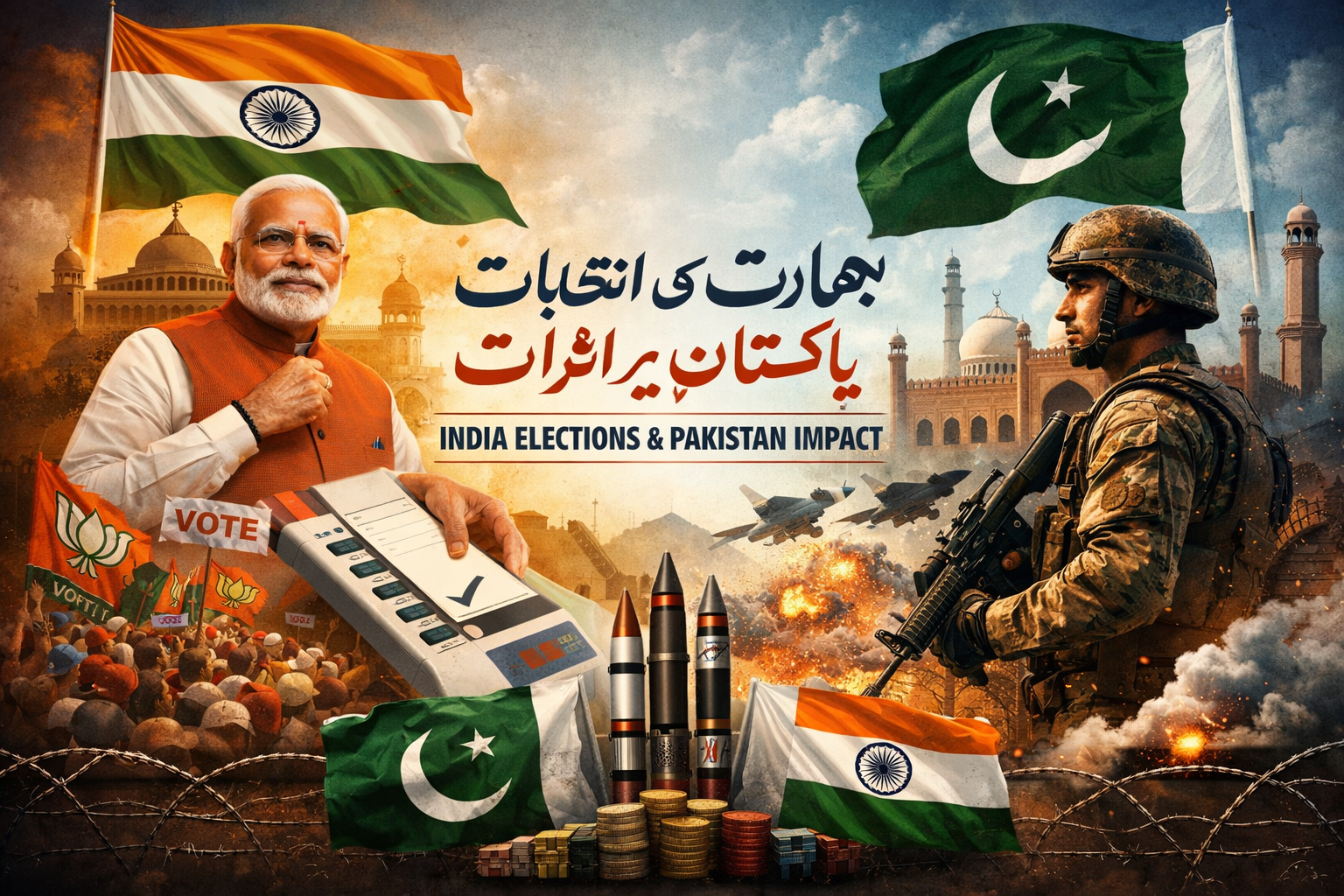
بھارت کی انتخابات، پاک بھارت تعلقات اور پاکستان پر اثرات ایک مفصل تجزیہ
India’s Elections & Pakistan: Geopolitics, Regional Stakes, and Future Impact
South Asia remains one of the most politically dynamic and strategically fragile regions in the world. With the 2026 elections in India unfolding as a decisive moment in New Delhi’s political landscape, the results will not only shape Indian domestic policy but also have far-reaching impacts on Pakistan’s national security, economy, diplomacy, and domestic politics. This blog explores those implications in depth — both from political narratives within India and the strategic ripple effects across the border.
🔎 1. What’s Happening in India’s Political Scene
India’s general elections in 2026 are being seen as not just a contest between political parties but as a referendum on nationalism, economic policy, and regional strategy. Prime Minister Narendra Modi’s Bharatiya Janata Party (BJP) seeks to extend its long-standing rule, while opposition coalitions have increasingly challenged its governance on issues ranging from inflation and unemployment to civil liberties and foreign policy.
Behind the polls is a narrative of majoritarian politics, deep social polarization, and an intensified use of digital media in campaigning. These factors shape not only the outcome but also India’s posture toward Pakistan after the votes are counted.
🇵🇰 2. Pakistan’s Security Calculus and the Indian Electorate
Security and defence concerns have historically played a significant role in Pakistani policy toward India. The memory of the 2025 Indo-Pakistan crisis — triggered after the Pahalgam attack in Kashmir and subsequent escalations — remains fresh. In April 2025, a militant attack in Indian-administered Kashmir killed dozens, leading to heightened diplomatic and military tensions between the two countries. India accused Pakistan of backing cross-border terrorism, a claim Islamabad denied and insisted on independent investigations. The situation escalated, resulting in temporary suspension of the Indus Waters Treaty, travel bans, border closures, and expulsions of diplomats from both sides. �
Wikipedia +1
This crisis influenced political discourse in India, where security narratives gained traction as the ruling establishment projected itself as the guardian of national strength and resilience. Such narratives are likely to influence voter sentiment and, by extension, New Delhi’s future policy toward Islamabad after the elections.
📈 3. Geopolitical Shifts: Bangladesh and the Balance of Power
While Pakistan and India remain central to South Asian politics, recent developments in neighbouring Bangladesh underscore shifting regional dynamics. The February 2026 elections in Bangladesh witnessed strong political pushback against India aligned narratives, opening space for Dhaka to pursue more independent foreign policy directions. This shift has been interpreted by analysts as an opportunity for Pakistan to strengthen bilateral engagement and diminish India’s longstanding regional footprint. �
The Friday Times
For Pakistan, this presents not only a diplomatic opening but a chance to reshape South Asian geopolitics in a more multipolar direction, reducing New Delhi’s ability to isolate Islamabad.
📊 4. Pakistan’s Strategic Room for Manoeuvre
Post-elections, Pakistan’s foreign policy options can be broadly categorized as:
🕊 Opportunity for De-escalation
If the Indian election results dampen hardline nationalist rhetoric — or if a coalition government emerges focused on economic development rather than aggressive posturing — Islamabad could explore confidence-building measures such as:
Reviving diplomatic communication channels
Resuming peace dialogues on Kashmir after decades
Strengthening economic cooperation with neighbouring states
Such a strategy could stabilize bilateral relations, potentially unlocking trade and investment avenues that have been dormant due to political mistrust.
🔐 Persistent Tensions
Alternatively, a decisive victory for India’s ruling party on a platform of strong security and national dominance could entrench existing divisions. In that scenario, Pakistan might:
Maintain heightened defence readiness
Deepen strategic ties with other regional partners
Elevate its case in international forums on issues of terrorism and peace
Either trajectory will depend heavily on post-poll narratives in India and how Islamabad navigates the evolving political environment.
💬 5. Domestic Politics and Public Sentiment in Pakistan
The impact of India’s elections is not limited to diplomatic halls; it also plays out in Pakistan’s public opinion and political sphere.
In recent months, public discourse in Pakistan has been shaped by how sports and politics intersect — notably the Pakistan cricket team’s boycott of the scheduled T20 World Cup match against India controversy. The decision, taken in solidarity with diplomatic tensions, polarized voices domestically and received international attention. �
ایکسپریس اردو +1
Former leaders and national icons, like Shahid Afridi, commented on the decision, highlighting how sports rivalry can mirror political antagonisms. This sentiment reflects a broader trend wherein geopolitical tensions increasingly resonate within domestic social arenas.
💼 6. Economic Implications
Although military and diplomatic tensions warrant attention, economic dimensions also matter. Experts have noted that while heightened Indo-Pakistan tensions can generate short-term strategic costs, they have not significantly disrupted Pakistan’s broader economic framework. As finance officials in Islamabad have indicated, Pakistan’s economy is resilient enough to manage such disputes without major financial strain. �
Dawn News
However, long-term economic prospects, including trade routes, border commerce, and regional economic cooperation, remain clouded by political uncertainty. The election outcome in India could influence how quickly bilateral economic initiatives resume.
✍️ Closing Thoughts: Elections Beyond Ballots
India’s 2026 elections are not a domestic or isolated event. The outcome carries regional repercussions — especially for Pakistan’s foreign policy, security strategy, and domestic politics. Whether these elections give rise to cooperation or deepen mistrust will significantly shape South Asia’s geopolitical contours in the years ahead.
Pakistan faces a pivotal moment: to respond with strategic foresight and diplomatic agility, or to remain entangled in cycles of confrontation. For both nations, the choices made now will define the subcontinent’s future — not just politically, but socially and economically.